HOT Search
Hot News

Product recommendation


Digital sensors are the core devices of the sensing layer. Their basic functional architecture is as follows: the built-in sensing element converts the physical quantity to be measured (such as temperature, pressure, light) into a continuous analog electrical signal (voltage, resistance or capacitance), and then the analog quantity is converted into a digital code value by the on-chip high-precision analog-to-digital converter (ADC).
Finally, the calibrated physical quantity value is transmitted to the main control MCU or application processor through standard digital interfaces such as I2C, SPI or UART .

Compared to traditional analog sensors that rely on external signal conditioning and independent ADC solutions, digital sensors integrate the entire signal chain from the sensing element to the digital output within a single package.
This significantly reduces system design complexity and board space while improving interference immunity. Currently, these devices are widely used in diverse scenarios such as industrial automation, automotive electronics, smart homes , environmental monitoring, and medical equipment , serving as a crucial bridge connecting the physical world and digital systems.
As shown in the typical architecture diagram below, a digital sensor is a System-on-a-Chip (SoC) that highly integrates the sensing element, PGA, high-precision ADC, digital filtering, non-volatile memory, digital compensation algorithm, and digital communication interface. This significantly reduces system design complexity and improves product reliability and consistency. Each unit in a digital sensor has a clearly defined function, including:
The specific function of a sensing element is to convert external physical quantities (such as air pressure, temperature, etc.) into detectable weak electrical signals. Taking digital sensors as an example, their MEMS sensing elements typically adopt a Wheatstone bridge structure, which has good detection capabilities and common-mode rejection characteristics.
It can effectively suppress some common-mode interference (such as power supply fluctuations, environmental noise, etc.), improve measurement stability from the signal source, and provide a foundation for high-precision detection.

Typical architecture diagram of a digital sensor (pressure)
The function of a PGA (Programmable Gain Amplifier) is to precisely adjust the gain of the weak signal output by the sensitive element before analog-to-digital conversion , so that the signal amplitude matches the dynamic range of the ADC input, making full use of the effective bit width of the ADC. At the same time, through low noise and low drift design, it reduces the error introduced by the analog front end, thereby improving the overall measurement accuracy and dynamic performance.
An ADC (Analog-to-Digital Converter) converts a gain-adjusted analog signal into a digital signal . Its advantages lie in reducing in-band quantization noise and improving effective resolution (ENOB) through high oversampling rate (OSR) and high-resolution conversion mechanisms , thereby achieving high-precision capture of minute parameter changes.
of a digital filter is to perform digital decimation, noise reduction, and bandwidth limiting on the ADC output data. It can effectively suppress the effects of noise such as mechanical vibration, power supply ripple, and power frequency interference, thereby improving the signal-to-noise ratio (SNR) and stability of the output signal. Its advantage lies in the ability to flexibly balance the device's response speed, output rate, and noise suppression capability by adjusting the filter parameters .
NVM (Non-Volatile Memory) is to store the calibration parameters corresponding to each chip, including zero-point deviation, sensitivity error, and temperature compensation coefficient .
The role of Full Compensation is to perform real-time compensation calculations on the raw data based on these calibration parameters, thereby effectively correcting individual device differences and temperature drift errors.
This eliminates the need for users to develop complex calibration algorithms, effectively improving measurement accuracy and reducing system development and mass production calibration costs.
an LDO (Low Dropout Linear Regulator) is to provide a clean and stable power supply for internal analog and digital circuits ; the function of a POR (Power-On Reset Circuit) is to initialize and reset the internal logic when the device is powered on or when the power supply is abnormal ; the function of an OSC (Internal Oscillator) is to provide a stable clock reference for ADC sampling, digital processing, and communication logic to ensure the consistency of internal signal processing timing ; the function of an I2C digital interface is to realize signal interaction between sensors and the main control MCU or peripherals .
Compared to traditional discrete sensing solutions, digital sensors can effectively reduce the number of external circuit design steps, lower the system development threshold, and improve the flexibility and reliability of product design, while having a higher application adaptability in modern electronic systems.
At the system application level, digital sensors can directly output standardized digital signals after internal processing, avoiding the attenuation and interference problems of analog signals during transmission, thus enabling sensor data to be transmitted to the main control system more stably.
For industrial equipment, smart terminals, and IoT applications that require multi-node deployment, this digital output method can effectively simplify the system architecture and improve equipment maintenance efficiency.
Meanwhile, digital sensors also have good platform compatibility, can be adapted to different types of processors and control systems, and are easy to deploy quickly in different application scenarios; in addition, digital sensors can adopt standardized and modular designs, which is conducive to large-scale production and rapid product iteration.
It is worth mentioning that, in practical applications, a high-performance digital barometric pressure sensor can not only provide higher quality data for upper-level control algorithms, but also achieve long-term stable and reliable operation.
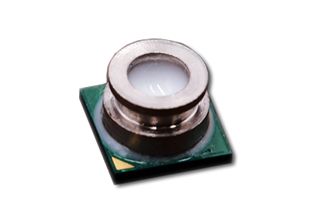
For example, the HP 203N is a high-precision digital barometric pressure sensor with a high-speed I2C interface , providing accurate temperature, pressure, or altitude data. Its pressure and temperature data outputs are digitized by a high-resolution 24-bit ADC, while the altitude data output is calculated from the pressure and temperature data using a specific algorithm .
Furthermore , the HP 203N integrates data compensation functionality ( using a dedicated algorithm ) to reduce the workload of the external host MCU system.

The HP 203N pressure measurement has a relative accuracy of ± 1.0 mB a r , supports a wide operating temperature range of -40℃ to 85℃, has a measurement range of 300 ~ 1600 Bar , and has a standby current as low as 0.1 μA, which can greatly reduce the power consumption of the terminal measurement.
The HP303B is a high-precision, low-power, compact digital barometric altimeter that uses capacitive pressure sensing to simultaneously detect air pressure and temperature. The HP303B features extremely low temperature drift and ultra-high measurement resolution. It has a built-in FIFO memory unit that can buffer 32 sets of measurement data, effectively reducing the polling load on the main control MCU. It supports both I2C and SPI communication interfaces and includes a built-in interrupt output function.

The HP303B uses a compact 8-pin LGA package, has a small overall size, and combines excellent environmental adaptability with ultra-low standby power consumption.

https://www.hoperf.cn/service/apply/
If you are interested in HOPERF's independently developed series of digital barometric sensors, please scan the QR code above or copy and open the link at the end of the article to apply for samples. We will be happy to serve you!