HOT Search
Hot News

Product recommendation


The Matter protocol is often called the " game changer " of the smart home industry , but what exactly has it changed?
Many consumers have likely had similar experiences when setting up smart homes : this smart light can only be controlled through one app , that smart door lock requires switching to another ecosystem, and before you know it, you have seven or eight control apps installed on your phone, and the devices can't even work together — over time, this " compatibility " obstacle has deterred many consumers and greatly limited the further development of the smart home market.

The Matter protocol is a "universal language" developed to address the aforementioned " compatibility " obstacles—the goal of the Matter protocol is to become an interoperable standard that promotes technology adoption and innovation.

The Matter Network Stack (Image source: CSA Alliance website)
From the perspective of the OSI reference model, the Matter protocol is a smart home application framework built on the application layer.
It achieves communication based on the TCP/UDP transport layer and the IPv6 network layer, and can be adapted to various underlying network technologies (such as Wi-Fi, Thread, and Ethernet).
In the field of smart homes, the breakthrough of the Matter protocol is not reflected in a single function, but in the collaborative design of a whole set of underlying mechanisms, which simultaneously exerts efforts on multiple levels such as device management, discovery methods, data expression, security models and ecosystem relationships.
First, in terms of local management , the Matter protocol introduces the concept of a distributed device catalog. Unlike traditional smart home systems that heavily rely on the cloud, the Matter protocol stores device capability descriptions, operating status, and related metadata on the local network, which is directly accessed and managed by the controller.
This design not only reduces reliance on cloud services but also significantly reduces control latency, allowing devices to maintain basic interoperability within the local area network even when the network is down.
In terms of device access and user experience, the Matter protocol implements a unified device discovery mechanism through mDNS/DNS-SD, enabling devices from different brands and ecosystems to be automatically identified and managed within the same local area network.
For users, the most intuitive benefit of this change is "plug and play," freeing them from being limited to the ecosystem of a single manufacturer.
Regardless of which smart home platform a user chooses, as long as the device supports Matter, it can be discovered, configured, and integrated into the existing system, significantly reducing the cost of system expansion and migration.
At the data model level, the Matter protocol uses a Cluster/Attribute/Command architecture to clearly and consistently define the functions, states, and executable operations of devices.
This means that similar devices from different manufacturers are semantically comparable and understandable, eliminating the need for separate platform adaptations for each manufacturer.
In terms of security, the Matter protocol makes security design a mandatory requirement. All communication must be encrypted based on TLS 1.2 or higher, and device-local communication uses an end-to-end encryption mechanism to build a secure communication link.
In terms of ecosystem compatibility, the Matter protocol's multi-administrator function allows the same smart home device to be controlled by multiple ecosystem platforms simultaneously without repeated network configuration. The multi-administrator function is a core feature of the Matter protocol in realizing the vision of user freedom of choice and interoperability.
In actual product deployment, the differences in power supply methods, real-time performance, and data scale among different types of smart home devices dictate vastly different choices of communication technologies.
Therefore, wireless communication solutions built around different application scenarios and deeply adapted to the Matter protocol have become crucial for device manufacturers to achieve product differentiation and rapid mass production.
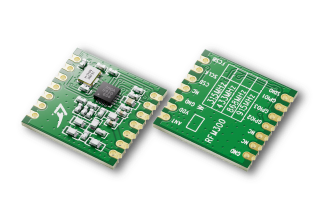
For example, the HM-MT2401 is a Matter over Thread wireless communication module based on the 2.4GHz band, which can enhance device communication distance, optimize device power consumption, and improve device communication security.
It has been widely used in smart home devices such as LED lights, wireless switches, smart door locks, smart doorbells, smart thermostats, and smart sensors.

The HM-MT2401 features an integrated PCB antenna and an external antenna mount, supporting wireless communication technologies such as Matter,
Thread, and BLE. It can be used to develop Matter over Thread terminal devices, helping them to quickly and stably connect to mainstream ecosystem platforms such as Apple Home and Amazon Alexa, while reducing the barrier to entry for users and the cross-platform development costs for manufacturers.
The HM-MT7201 is a Matter over Wi-Fi wireless communication module based on the 2.4 GHz band, designed for compact applications.
The HM-MT7201 integrates a PCB antenna and supports wireless communication technologies such as Matter IoT platform, Wi-Fi, and BLE.
It has been widely used in smart home devices such as HD cameras, audio equipment, and video doorbells.

The HM-MT7201 is a highly integrated single-chip Wi-Fi 802.11b/g/n and Bluetooth Low Energy (BLE) solution. It features a built-in high-performance MCU and ample storage resources, providing excellent wireless performance and rich peripheral interfaces.
This allows manufacturers to quickly upgrade lighting, switches, sockets, door locks and other devices into Matter-compliant smart home products, accelerating development and time-to-market (by up to 70%).

https://www.hoperf.com/service/apply/
If you are interested in HOPERF's independently developed Matter modules, please scan the QR code above or copy and open the link at the end of the article to apply for samples. We will be happy to serve you!