HOT Search
Hot News

Product recommendation


Currently, the smart home industry is at a critical stage of transition from "single-point interconnection" to "whole-house intelligence".
In the industry landscape where multiple ecosystems are developing in parallel, how to enable smart home devices from different brands to break through ecosystem barriers and solve problems such as fragmented device access, fragmented scene linkage, and inconsistent user experience has always been an important challenge for the industry to achieve "ecosystem integration and user experience upgrade".

The Matter protocol, as a globally unified smart home connectivity standard, is the key to overcoming this predicament. Based on a unified IP network framework, it does not set exclusive network ownership or access rights and supports multiple communication protocols such as Thread, Wi-Fi, and Ethernet to run on a unified IPv6 network platform.
All kinds of ecosystem devices can access and share underlying network resources equally based on the standard IP protocol stack, breaking down the barrier of "one ecosystem, one network" from the root.
Under this mechanism, the same physical network can simultaneously carry the device and service traffic of multiple ecosystems, and a single device can also achieve multi-ecosystem access through a standard IP interface without the need for additional protocol conversion and gateway adaptation, truly paving the way for seamless cross-ecosystem integration of devices.
In the early stages of exploring cross-ecosystem interconnection, the industry generally adopted two types of solutions: gateway compatibility and cloud-to-cloud integration. However, these are essentially "patch-style" shallow integrations that fail to solve the problem of ecosystem fragmentation at the architectural level.
They can only achieve command interoperability in limited scenarios and cannot achieve native compatibility of device capabilities and seamless unity of experience.
The Matter protocol redefines the interconnection logic of smart home devices from three dimensions: device identity, network affiliation, and functional abstraction.
Its core is not simply to establish a new communication link, but to transform the originally fragmented smart ecosystem into a collaborative and scalable open network system through a unified device model, security system, and application layer architecture.

The Matter protocol introduces a key abstract concept, Fabric, in its architecture. Fabric is not a physical network in the traditional sense, but a collection of Matter devices that logically establish trust relationships, corresponding to a virtual security domain built by a certain smart ecosystem.
In the Matter system, the same device can be added to multiple Fabrics at the same time. For example, it can be added to the Apple Home ecosystem and Google Home ecosystem for home user interaction, as well as a private control system for local automation scenarios.
Different Fabrics share the same physical device resources, but have independent security credentials and permission management systems, which can achieve the coexistence of multiple ecosystems without the need to deploy multiple gateways or perform repeated network configuration.
On top of Fabric, the Matter protocol also builds a unified device model through Nodes and Endpoints to achieve standardized descriptions of devices and their functions.
In the Matter system, a Node represents an independent addressable Matter device, which is the basic unit for devices to access the network and conduct secure communication. For example, smart air conditioners, smart door locks, and smart lights all correspond to a Node in the Matter network and can be identified and invoked by different ecosystems.
Internally, Nodes further break down device functions through Endpoints. An Endpoint can be understood as the logical entry point for different capabilities of a device, used to describe specific functional modules.
For example, in a smart air conditioner, Endpoint 0 describes basic device information, such as manufacturer, model, and firmware version; other Endpoints can correspond to functions such as temperature control, airflow adjustment, and energy consumption monitoring.
This layered design shifts Matter's focus from controlling the "entire device" to transforming the device into a collection of capabilities that can be invoked on demand by different ecosystems. For example, a home automation system can access the temperature control capabilities of an air conditioner, while an energy management system can access its operating status and energy consumption data.
The core value of the Matter protocol lies in establishing a unified and open connectivity standard, which fundamentally reshapes the development logic of smart home device manufacturers.
In the past, developing a smart device that could adapt to different platform ecosystems required a lot of repetitive work; in the future, as long as the product conforms to the Matter standard, it can seamlessly connect to multiple smart home ecosystems.
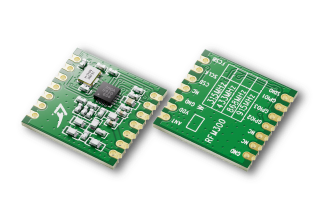
Currently, one of the fastest ways to develop Matter products is to directly use Matter modules. Developers only need to integrate Matter modules into smart home terminal devices (such as lights, switches, sockets, door locks, curtain motors, doorbells, thermostats, sensors, etc.) through simple interface design.
This allows them to quickly upgrade existing terminal devices to Matter devices that meet Matter standard specifications at a lower cost and in a shorter cycle.

For example , the HM-MT2401 is a Matter over Thread wireless communication module based on the 2.4GHz band . It utilizes the high-performance, highly integrated RF processing chip EFR32MG24, with an embedded 32-bit ARM® Cortex®-M33 core, supporting wireless communication technologies such as Matter, Thread, and BLE. It can be used in low-power terminal devices such as door locks, sensors, smart switches, and thermostats, helping traditional products quickly upgrade to smart home devices that meet the Matter standard.

The HM-MT7201 is a Matter over Wi-Fi wireless communication module based on the 2.4 GHz band. It is a highly integrated single-chip Wi-Fi 802.11b/g/n and Bluetooth Low Energy (BLE) solution designed for compact applications.
Internally, it integrates a powerful 32-bit MCU and a comprehensive set of peripheral interfaces, offering high integration and low power consumption in a tiny package .
For home appliances such as TVs and cameras that require high-bandwidth communication capabilities, this type of Matter over Wi-Fi solution can more efficiently achieve device networking and scene linkage.

https://www.hoperf.cn/service/apply/
If you are interested in HOPERF's independently developed Matter modules, please scan the QR code above or copy and open the link at the end of the article to apply for samples. We will be happy to serve you!